


By Khairie Hisyam

After the third generation of IPPs, the power sector saw several reform initiatives. While the incentive-based regulation (IBR) framework and power purchase agreement renegotiation brought some savings, the big one is the promise to award IPP licences through competitive bidding — which the Energy Commission did not do for Track 4A.
____________________________________________________________________
In the days after former prime minister Dr Mahathir Mohamad’s retirement, the power sector saw several long-awaited reforms emerge.
Among others, the government made a commitment to the open tender process for the award of independent power producer (IPP) licences from 2005 onwards. This followed the establishment of the Energy Commission (EC) in May 2001 to replace the now-dissolved Department of Electricity and Gas Supply.
A statutory body set-up under the Energy Commission Act 2001, the EC is tasked, among others, to promote efficiency and economy in the power supply chain as well as ensuring a competitive electricity and piped gas industry.
In 2010, special purpose unit MyPower Corporation was formed under the Energy, Green Technology and Water Ministry (Kettha) to drive reforms in the power sector. Its primary objective was to review and recommend key reform initiatives for the sector.
Subsequently, in August 2013 a regulatory framework called the Incentive Based Regulation (IBR) — also called performance-based regulation in some parts of the world — was approved by Putrajaya in August 2013.
Incentives for efficiency
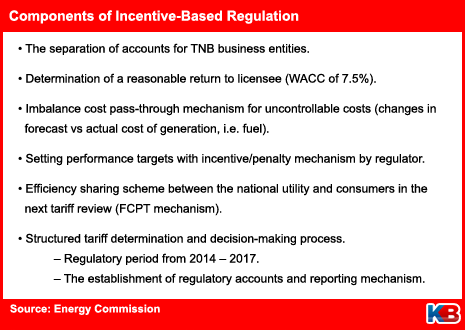
In a nutshell, the IBR is a set of economic regulation methods put forward by the Energy Commission (EC) to encourage efficiency and transparency through a mechanism of incentive and penalty.
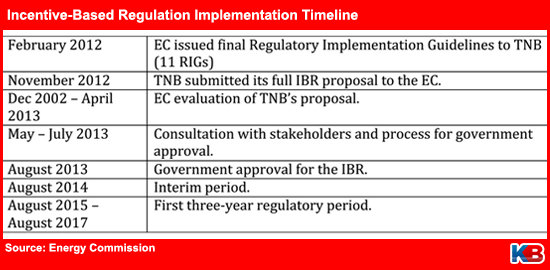 There are three broad efficiency categories, namely operational, financial and performance. The system works through three-year regulatory periods — incentives or penalties for one regulatory period would be imposed in the following regulatory period, while efficiency gains would be shared in latter.
Over the span of three years beginning financial year 2015, the efficiency is set to save national utility Tenaga Nasional Bhd (TNB) some RM700 million, according to the EC.
Both the EC and TNB has stated that the savings would be passed on directly to consumers.
Passing on fuel costs
Part of the IBR framework is the fuel cost pass through (FCPT) mechanism which essentially ensures that TNB would be able to pass on additional costs or savings from fluctuating gas prices to consumers.
Set for a trial run from financial years 2015 to 2017 — the first regulatory period under the IBR — the FCPT mechanism would ensure that TNB can enjoy profits based on a weighted average cost of capital (WACC) of about 8% and earnings upside from being efficient.
 This is similar to current practice in developed countries such as Australia and the United Kingdom. Malaysia had its first taste of the mechanism in June 2011 when the natural gas price was readjusted to RM13.70 per million metric British thermal unit (mmbtu).
Prior to the revision, the price was RM10.70 per mmbtu. In January this year the nation saw an upward revision of electricity tariffs for Peninsular Malaysia and Sabah due to, among others, a revision of the natural gas price from RM13.70 per mmbtu to RM15.20 per mmbtu, according to TNB.
The mechanism presented a positive step forward given that it was first promised in the 1990s when TNB was first floated on the stock exchange. In addition it also reduces burden on Petroliam Nasional (Petronas) which had been providing gas at subsidised rate — RM13.70 per mmbtu — effectively forgoing a portion of revenue.
However the next tariff review date according to the FCPT mechanism, July 1, 2014, passed without any tariff revision.
“We believe that any tariff hike announcement now would be subject to a public backlash. The situation is made worse by the recent Track 4A fiasco involving YTL Power,” said a CIMB Research report. “However, we believe that Tenaga will get its tariff hike, albeit slightly delayed.”
Half a billion saved from PPA renegotiations
To offset higher fuel costs in the meantime without a tariffs revision, reform unit MyPower Corporation had suggested that Putrajaya tap into savings of RM500 million, which were accrued following the renegotiation of several power purchase agreements (PPAs).
Derived from a reduction of capacity charges, the savings were gained from renegotiating the terms for Genting Sanyen Power Sdn Bhd, Segari Energy Ventures Sdn Bhd and TNB Pasir Gudang.

Abdul Razak Abdul Majid
“We have accrued a little bit, amounting to some RM500 million, in slightly over a year when the first-generation IPPs reduced their capacity payment following a renegotiation of terms when their contracts were extended for another 10 years,” EC chairman and MyPower special advisor Abdul Razak Abdul Majid was quoted as saying. “This is savings that was derived from March 2013 after the PPAs were renegotiated for three IPPs.”
Genting Sanyen and Segari Energy are both first-generation IPPs while TNB Pasir Gudang is currently a unit of TNB but will begin operating as an IPP after 2017.
More savings through competitive bidding
Yet savings through the IBR and PPA renegotiations pale in comparison to a reported RM4 billion saved by awarding IPP licences through competitive bidding as opposed to direct negotiations.
The savings through open tender IPP licence awards go directly to the end-consumers, said the Association of Water and Energy Research (AWER) Malaysia, as it is accrued from pressure to minimise costs on the bidders’ part.
“If a bidder bids at 35 sen per kilowatt hour (kWh) in levelised tariff and someone else bids at 30 sen per kWh, that’s a direct saving,” said AWER president S. Piarapakaran. “Consumers — not just households but businesses etc — don’t need to pay the extra five sen per kWH for electricity.”
Since 2011, the EC had conducted four competitive bidding for fourth-generation IPP licences. The first, dubbed the Track One power project, was won by TNB in October 2012, reportedly edging out 17 other bidders.
The power project would see TNB constructing and operating a 1,071 MW combined cycle power plant in Prai. News reports placed TNB’s bid at a levelised tariff of 34.7 sen per kilowatt hour (kWh) and an internal rate of return (IRR) of between 6% and 7% for the project.
Track Two entailed a 10-year extension to first-generation IPPs Genting Sanyen and Segari Energy while TNB won the third competitive bidding in August 2013, Track 3A, to construct a 1,000 MW brownfield coal-fired power plant in Manjung, Perak.
The fourth competitive bidding, for the Track 3B project, was won by a consortium led by 1Malaysia Development Board (1MDB), edging out stiff competition from YTL Power International which was previously reported to be the frontrunner for the 2,000 MW power project.
Track 4A direct award — a regression?
However, Track 4A power project, the fifth under the fourth generation, saw a reversal from the competitive bidding process trend set since 2011.
The multi-billion power project was conditionally awarded to a consortium comprising YTL Power International Bhd, Tenaga Nasional and SIPP Energy Sdn Bhd — the latter being the Sultan of Johor’s vehicle — by the Energy Commission on May 27 this year.
Made through direct negotiations, the offer was extended due to the consortium members’ ability to offer competitive rates during previous tender exercises, said the EC. In a later media statement, the commission noted that the project site was selected based on available TNB land.
 “Definitely (a regression),” said AWER president S. Piarapakaran, adding that it is puzzling why the EC had not withdrew the offer given that YTL Power has dropped out. “As a government-linked company (GLC) TNB should reject the offer because competitive bidding was a government promise (for the sector).”
The AWER president is referring to repeated commitments made by the government to the open tender process in awarding IPP licences, among others made in the 10-year GLC transformation programme announced in 2005.
Additionally the EC itself, in a 2013 report, outlined competitive bidding as key part of the Malaysian Electricity Supply Industry (MESI) reforms, without mentioning any other methods such as direct negotiations or restricted bidding. Nor were alternative methods mentioned by the Kettha minister Maximus Ongkili in the Economic Transformation Programme (ETP) Annual Report 2013 in terms of plant-up strategy.
Apart from the contrast to recent and promised practices, the direct award also raised eyebrows as it was extended just eight days after EC chairman Abdul Razak was quoted as saying there would be no direct negotiations.
News reports in May previously quoted Abdul Razak as saying the commission had not received any instructions from authorities to engage in direct talks for the project, though he was later quoted as saying he would consider direct negotiations if told to do so.
Following the abrupt U-turn, EC member Mohd Nasir Ahmad resigned due to unhappiness over how the Track 4A power project was awarded. Another member, Abdul Razak’s predecessor Ahmad Tajuddin Ali, was also believed to have resigned for similar reasons.
However on June 17, following heavy controversy over YTL Corp managing director Francis Yeoh’s ‘crony capitalism’ remarks, YTL Power declined the offer and the EC accepted the decision on June 18.
Do IPPs struggle with open tender?
In any case, it is notable that no IPP, except for 1MDB, has won a competitive bidding process for power projects.
 Apart from the Track Two extensions, TNB has won two while state investment fund bagged Track 3B power project. Both are government-linked — 1MDB is a state-investment fund while TNB counts another state investment fund, Khazanah Nasional Bhd, as a major shareholder with 32.42% alongside Ministry of Finance’s Employees Provident Fund (EPF) which has 10.74%.
The heart of the issue seems to be TNB’s lower financing costs as a sovereign-backed entity, which 1MDB presumably also enjoys. This allows for lower bids that IPPs are finding difficult to match.
“Being a company owned by the Ministry of Finance, (TNB) enjoys lower cost of financing, enabling them to offer tariff at about 10% lower than other bidders,” said Zainal Abidin Jalil, former honorary president of PenjanaBebas, to KiniBiz last August. “This has created a non-level playing field for other bidders and potential investors.”
An underlying question here is whether IPPs, struggling to compete with sovereign-backed players in terms of matching tariffs, should be a part of Malaysia’s long-term electricity supply picture.
Yesterday: The issues with IPPs
Tomorrow: Are IPPs part of our future?
You must be logged in to post a comment.