


By G. Sharmila
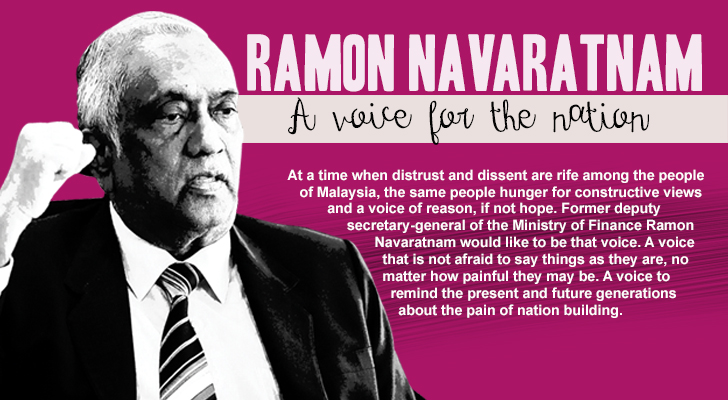
In our past article, Ramon Navaratnam spoke about the state of our nation and the things he would like to see changed. In this article, he speaks to KINIBIZ about the Malaysian economy, including fundamentals and how he views the direction of the ringgit.
________________________________________________________________________
“In the new economy, information, education and motivation are everything.” – William J Clinton, former United States president.
Malaysia is gearing up for developed nation status in 2020. But with the weakening ringgit and soft global economic conditions, that goal seems to many a distant dream for now. Are we getting there? Or is it all a pipe dream? Ramon Navaratnam shares his views…
What about economic fundamentals, where do you see our economy going?
Recently I had the flu, I chaired the World Bank conference, and I chaired the Bankers summit. I was already not well but I pushed myself and got ill. The doctor told me I had bronchitis so I was admitted for three days. You can be healthy today and boast about it but tomorrow it is possible that you will get exposed to somebody’s bad flu and if you don’t treat yourself, get the right reform, right policy, you can deteriorate rapidly particularly if your resistance is low, and I am saying this is the state of our economy – we are strong but our resistance is low. Your fundamentals are strong but margins are narrow for maneouvering.

Ramon Navaratnam
What are the indicators?
The deficit is just about 3.2% of the gross domestic product (GDP) and we are trying to get to 3%, so 3.2% is now healthy but it can be wiped out, if a flood hits and billions need to be spent. Our head is just above water and we are floating comfortably, but when a big wave comes we can be in trouble. The balance of payments, current account have been declining… The ringgit (decline) Bank Negara says is temporary, but how temporary is temporary?
Is it going to pick up tomorrow, a day after tomorrow? Next month? Next year? And people have a lot of spin – partly the press is to be blamed. Spin is to say the currency has gone down (which) is a good thing, exports will do well.
To illustrate, suppose you buy a dress of a certain make, such as Christian Dior, are you going to change to another brand from another country because the price is lower through the exchange rate? No. It doesn’t change overnight. It’s not so price elastic, it cannot change overnight. It’s a long-term issue – people will still go for quality and standards, market availability, delivery and distribution. But import prices immediately go up, you don’t have to persuade people to buy more unlike exports. You’re going to have imported inflation, because the exchange rate has gone down and is unlikely to go up.
The exchange rate is like a thermometer in simple terms: if you take your temperature and it’s going up, you cannot say it’s temporary, you have to treat it, and you can’t say there’s nothing wrong with the temperature going up – it shows our weakness.
That’s what they are not highlighting; that’s the difference between group A and group B. The establishment will find some way to give you a spin, but is it sustainable? You know how much harder you have to work in order to buy the same thing at a higher price now if it’s imported? Simple goods and services don’t need to be imported but if you want to develop you need machinery and equipment which are going to be imported. Even coaches for the MRT have to be imported.
Different people have different outlooks for the ringgit. Some foreign economists do not think it will rebound before next year.
I will be pleasantly surprised if it rebounds even next year, because what will change for it to rebound? To me I am a macroeconomist – I look at all factors. The underlying word which will determine whether the currency goes up or down, the economy moves forward or backward, is confidence.
For example, if you feel prices are going up, will you want to buy things? Because you are afraid that if you buy you have no savings, and private consumption is 50% of our gross national product (GNP). It’s sizeable so if that goes down the economy will go down.
Private investment… Your prices are going up, exchange rate going down, are you gonna put money here for investment? You have no confidence, foreign investors are not coming here due to the low yield for investments… It affects the whole system.
So what do you believe needs to change and what can be done?
Firstly, move away from New Economic Policy (NEP) to the New Economic Model (NEM) at a faster pace – we are moving but too slow. Two, phase out bumi/non-bumi dichotomy which does not encourage confidence in the future and which preaches protectionism and not better performance, competition and meritocracy.
Three, ensure measures to stop or to slow down the brain drain because no brain, no investment; less brains, less progress.
Four, find out why there is a massive capital outflow, maybe the highest per capita in the world. They say China is the highest but look at their population. Have a task force to study measures to discourage this outflow… Make it more attractive to invest in Malaysia.
 As for education, improve the quality much faster, then you will not have hundreds of thousands of unemployed graduates who can be the cause of major social upheaval and unrest… They will be the first to demonstrate sometimes. We are talking about changing education and reforms in the future, not now… People are thinking, now we are comfortable.
Using an analogy, the frog has a special quality. If the water in the pot gets warm, they adjust to it, and if it gets hotter and hotter, it will adjust. It can jump but it doesn’t, and in the end, you get good frog soup! So we are still adjusting mildly with the weather, and the turmoil, and the uncertainty is growing – forces of globalisation and TPPA are happening, we can’t hold the world.
We are caught in all kinds of conflicts. The mindset has not changed although the environment has changed. We can be like Nero fiddling with his violin while Rome is burning. We can be like King Canute who just asked the floods to go away, but the tide did not go away. We are good now but how long can it last without undertaking major reforms, and what is our sustainability?
Yesterday: Patriotism in trying times
Tomorrow: Reforming a nation
You must be logged in to post a comment.