


By G. Sharmila
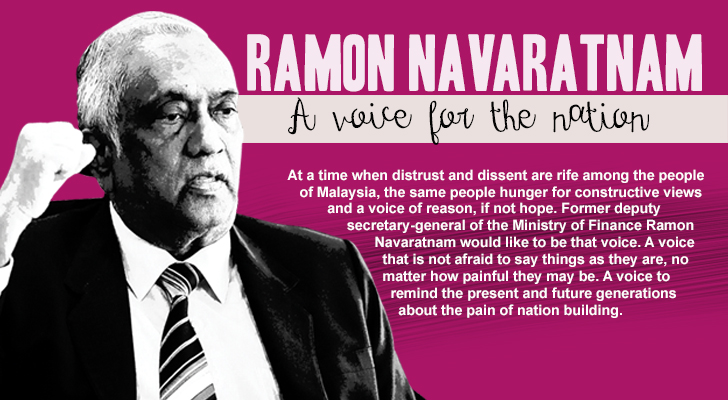
When a country is facing tough times, the voice of dissent tends to override that of reason. However, there are some among us still who believe in the patriotic spirit and temper this with reason. They have stories to be told too, and one such person is Ramon Navaratnam.
________________________________________________________________________
“To me a real patriot is like a real friend. Who’s your real friend? It’s the person who tells you the truth. That’s who my real friends are. So, you know, I think as far as our country goes, we need more people who will do that.” – Bill Maher, American comedian and political commentator.
KINIBIZ recently spoke to 80-year-old Ramon Navaratnam, former deputy secretary-general of the Ministry of Finance and former secretary-general of the Ministry of Transport. By his own admission, Navaratnam spent 30 years in the civil service and 20 years in the corporate sector, where he is currently the corporate advisor to the Sunway Group. Here’s what he had to say on the state (and future) of the nation…
What are your thoughts on the state of the nation?

Ramon Navaratnam
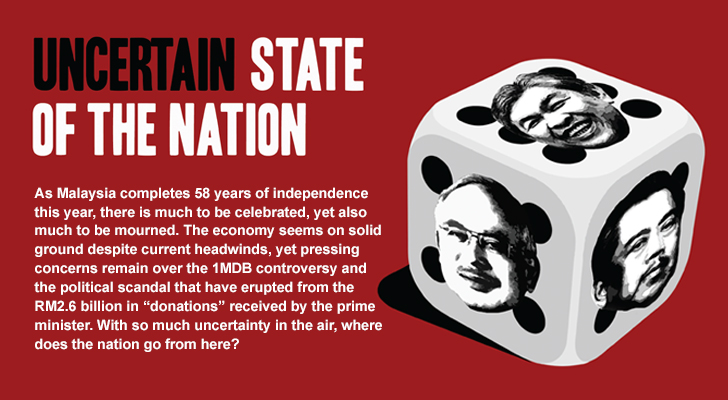
The way I see it, there is a major conflict in the country today between those, for their own reasons, who seek to talk about the present and the past on one side – and that involves mostly the government – and on the other side, people who are very keen to know where we are going in the future. They look not only at the present time but the prospects in the future, and you can get two diametrically opposite views like what were expressed in the Idris Jala and the Pesek debate (referring to his own article at Malaysiakini.com).
They’re both right but one looks at the short term and does not comment much on our weaknesses, the other side talks about, well, the good position that we are in now, but like me, we worry about the future, because of issues like political uncertainty, issues like Islamisation and racial polarisation.
And I was on the National Unity Council, I should know something. I was chairman of one panel on inclusiveness, that’s why I feel quite strongly that unity and disunity can play a major role in our future prospects and outlook.
Let’s go back to your first point. You talked about conflict in the country and there being two camps of people. Which camp do you support?
There are the establishment and the non-establishment types, the government and the opposition probably. I am in between – I am not a politician, I have not been involved in any political parties. I have been a true civil servant, I dare say an honest civil servant, and purely professional. My only weakness, if at all, is that I am a nationalist, born and bred a true Malaysian regardless of race and religion. That’s how my generation was brought up, the generation of Tunku Abdul Rahman, Tun Razak, Tun Hussein Onn, the generation of ministers of finance like Tun Hussein Onn and Tengku Razaleigh.
What is different now in the civil service, seeing that you’ve been in the civil service most of your life?
Thirty years of my life, and 20 years now in the private sector, so I think I know both sides. Not many people have worked 30 years in government and 20 years in the private sector in the corporate side, so I can compare and contrast quite easily.
I sigh and say it’s a huge difference. We were much more multiracial, multicultural and Malaysian in our outlook, because the school and university system back then generated graduates of that calibre because there was only one university for both Malaya and Singapore, the time I was at the university. It was very exclusive, and we concentrated on quality and competition and meritocracy.
 Today there are at least 50 public and private universities and hundreds of colleges, so the emphasis on quality and meritocracy is much, much less and because there is divergence between public and private institutions, there is much less cohesion and a sense of inclusiveness and Malaysian-ness because you go to schools, colleges and universities that are dominated by one race or the other. The public universities are Malay universities, private universities are non-Malay, so when you go to those streams there’s a problem. And then you have the Biro Tatanegara which by all counts spews racial poison with public funds. It has been criticised but little has been done to change it, so one question is on how serious the government is at promoting Malaysian unity or Malay unity.
There are very strong elements of state capture, a relatively new term in governance coined by the World Bank, and to paraphrase, it means the art of governments all around the world in utilising and manipulating all the institutions of state like the political system, the electoral system, police, judiciary, civil service and any institution to benefit the government in power, and to ensure as far as possible its continuity. And we in Malaysia have a problem, because we may be, besides Singapore, the only government in the world which has had the same political party since independence, or for as long as 58 years.
Tomorrow: The state of our economy
You must be logged in to post a comment.