


By Chan Quan Min
 Financial losses aside, Malaysia Airlines has been dealt a reasonably good hand. Passenger numbers are up 30% this year on record passenger loads. All that remains is for the airline to play its cards right. The game is yield management and the stakes are high.
Malaysia Airlines is close to clocking up five whole years in the red. That’s half a decade. What an astonishingly long bout of unprofitability!
Tell that to Tiger, us big cats can count on a lifespan of just about 20 years, and a little more depending on luck. Regardless, Tiger’s lifespan is more than long enough to see Malaysia Airlines go through its many ups and downs.
Tiger recalls Malaysia Airline’s current predicament as certainly not the first time the flag carrier has been flying through turbulence; Malaysia Airlines is now in its third corporate turnaround in recent history.
The national airline’s current financial troubles started way back in 2009. The year was especially difficult for the aviation industry. The global financial crisis hit hard that year and not one airline was spared.
While practically every Asian legacy airline has recovered since, Malaysia Airlines, ever the laggard, has not.
Signs of a recovery emerged earlier this year, when the airline began to report promising operational statistics. This year so far, passenger numbers have grown almost 30%, concurrent with increases in load factor to 10-year highs.
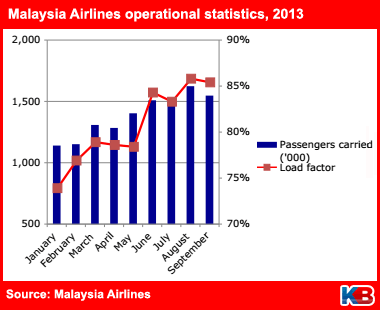 But operational statistics such as passenger numbers and load factors can be misleading. Those in the know look at indicators that take into account revenue generation. These indicators include RPK, short for revenue passenger-kilometre and passenger yield.
RPK is calculated by taking the number of paid seats multiplied by kilometres flown while passenger yield, in general terms, is a unit measure of average airfare. Airline managers are trained to look at these vital indicators. The field of study is called revenue management or even sometimes, yield management.
In managing an airline, aviation professionals balance a multitude of influencing factors to coax maximum revenue from finite seat capacity. Revenue management is based on price optimisation strategies; knowing when and which price to charge for an air ticket.
Before Tiger digresses further, Tiger ought to go in for the kill and strike while the iron is hot. The killer question here for Malaysia Airlines is: What has happened to your yields this year?
Tiger will gladly answer on behalf of Malaysia Airlines. Since it takes ages to get a response from their corporate communications team, Tiger has taken the liberty to research the numbers himself, by calling up research analysts that cover the company.
Yields have crashed (pardon the unintentional pun) spectacularly this year. In the third-quarter alone yields are down by as much as 17% year-on-year, while for the year to date yields are down by about 13%.
What does it mean for the national airline? It means in order to break-even, Malaysia Airlines needs to lower its costs by about a similar amount, if not more.
Why yields have collapsed this year, and by such a large percentage is because the national airline this year started an aggressive expansion, adding countless domestic flights, and to a lesser extent, international flights.
And to fill all those extra seats at short notice, the national airline has had to discount heavily. What better way is there than discounts to entice passengers to your airline?
So there you have it. In a nutshell, more flights equals more seats to fill equals discounts to persuade passengers to fly the airline. Is this strategy sustainable? Perhaps, if costs fall in line with the decline in yield.
But costs can be downwards sticky, so at some point, if the national airline wants to break even, it has to raise yields, plain and simple.

Ahmad Jauhari Yahya
To give Ahmad Jauhari Yahya, the CEO of Malaysia Airlines some credit, the man has suggested that the carrier must now try to improve yields in 2014. According to the airline’s senior management, Malaysia Airlines has been pricing competitively (hence the low yields) to attract customers to try out its newly improved product.
And, management also contends, the extra flights are flown with the same amount of planes as before simply because the airline has gotten better at extracting higher utilisation of assets.
Now that Malaysia Airlines has attracted record numbers of passengers all that remains is to raise prices slightly, not too high as that might turn away customers but just enough to turn in a decent profit.
In other words, Malaysia Airlines must now find the sweet spot when it comes to its pricing strategy, or in other words, revenue management.
When they do, they might actually post a profit and Tiger will promise to quit being so critical of their management style, at least long enough to congratulate Jauhari and his dedicated team.
Until then Tiger will continue to stalk Malaysia Airlines, making them look over their shoulder.
GRRRRR!
You must be logged in to post a comment.