


By Chan Quan Min
 KiniBiz deduces how a merger between CIMB Group, RHB Capital and Malaysia Building Society Bhd (MBSB) will likely take place based on information obtained from sources close to the merger discussions. As much as possible this merger will be fair to shareholders. A takeover has already been ruled out, despite CIMB’s obvious heft.
____________________________________________________________________
It is early days yet for the planned merger between CIMB Group Holdings Bhd, Malaysia Building Society Bhd (MBSB) and RHB Capital Bhd but several pertinent details made available to KiniBiz today can help to piece together how the merger is likely to pan out.
What is clear is that formal negotiations for a three-way merger have not begun. But they will begin in earnest from tomorrow after Bank Negara clearance was given today.
In a joint statement today, the three parties said they have “entered into a 90-day exclusivity agreement to negotiate and finalise pricing, structure, and other relevant terms and conditions for a proposed merger… and the creation of a mega Islamic bank.”
On the surface, a three-way merger of CIMB, MBSB and RHB is neither improbable nor difficult.
All three financial services firms – only CIMB and RHB are full-fledged banks – share a common shareholder in the Employees Provident Fund (EPF). The public pension fund holds a 16% stake in CIMB, 65% of MBSB and 41% of RHB.
In addition, state investment holding company Khazanah Nasional has a 30% equity stake in CIMB.
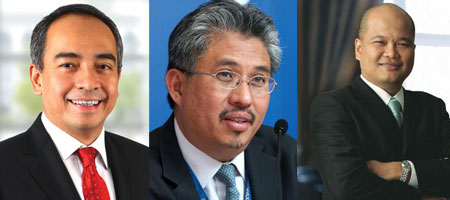
(From left) Nazir Razak, Azman Mokhtar, Shahril Ridza Ridzuan
Thus, the negotiating table is likely to be dominated by the likes of Nazir Abdul Razak of CIMB, Shahril Ridza Ridzuan of the EPF and Azman Mokhtar, the long-serving CEO of Khazanah Nasional.
Shahril, who was installed as CEO of the EPF just last year has long sought to combine MBSB with RHB, a logical conclusion given that the EPF has a controlling stake in both.
The real surprise to industry observers has been the involvement of CIMB in the deal. Recent years have seen CIMB expand outside Malaysia, not inside the country’s borders.
One casual observer said, after giving it some thought, that the deal did not seem so out of the ordinary. After all, CIMB has always been “obsessed with chasing after the top spot.”
 Combined, the merged entity of CIMB, RHB and MBSB would have total assets of RM614 billion, according to latest available figures. In comparison, the country’s largest banking group for decades, Maybank, has total assets of RM579 billion, slightly lower.
On the stock exchange, the newly merged entity could be valued at RM89 billion, all things being equal, just shy of Maybank’s RM91 billion. The merger will give birth to a banking behemoth.
A true merger, not a takeover
Of possible merger scenarios, a takeover of smaller MBSB and RHB by much larger CIMB has apparently been ruled out. By most metrics, RHB is approximately half the size of CIMB. In turn, MBSB is between a quarter and one-fifth the size of RHB.
According to a well-informed banking source, the three-way union will be, as much as possible, a “true merger” where no shareholder is to be disadvantaged. “Everyone will have a stake in the new entity,” the source assured.
Given the circumstances, the most likely outcome would be a merger by share swap, where shareholders of the three financial groups entering into the merger will receive their weighted share of the post-merger entity.
An interesting exercise in arithmetic would be to predict who the major shareholders will be. Without a doubt, the EPF and Khazanah will have a significant decision-making influence over the newly formed entity provided they do not divest their equity stakes.
 Back of the envelope calculations reveal that the EPF will end up with about 25% of the newly merged entity while Khazanah will not be far behind with about a 20% stake. These figures are weighted averages based on market capitalisation.
Together, the two government-controlled bodies will have residual equity ownership of about 45% of the newly formed entity, a considerable share of the pie and more than sufficient to qualify as a controlling stake.
Composition of shareholders aside, the single most important consideration for the EPF, Khazanah and other shareholders ought to to be the value the merger can deliver. After all, a merger is only worthwhile if it benefits its shareholders.
Value accretive or value destructive?
An early report by UOB Kay Hian this morning has suggested that the new banking behemoth of CIMB, RHB and MBSB could turn out to be “value destructive” for its owners. The report is not conclusive, of course, because UOB Kay Hian does not have intimate knowledge of the CIMB, MBSB and RHB merger.
“We opine that such a merger could be value destructive to the merged entity given the degree of operational and revenue duplications between CIMB and RHB Capital,” said UOB Kay Hian analysts.
“Both banks have among the highest cost-to-income ratios in the industry,” they noted, saying this was due to “the fact that both banks continue to struggle with respective post-merger and acquisition integration costs.”
Sources close to the deal however say Nazir is not one to proceed with the planned merger if it turns out to be “value destructive” after due diligence takes place. Nazir is known in banking circles for his corporate savvy, a reputation he probably wants to maintain.
CIMB management has apparently “not worked out details with RHB,” the second largest party to the planned merger but are confident that there is a ”good chance for value creation,” the source told KiniBiz.
According to the source, CIMB has long considered RHB an “operational fit” with its own business. This would be the third time in recent memory that CIMB has tried unsuccessfully to merge RHB into its operations.
In February 1998, the Bank of Commerce, a predecessor of present day CIMB, got central bank approval to negotiate for a merger with RHB.
Again in 2011, CIMB and rival Maybank were separately in the running to snare RHB. But any chance of a merger with either suitor vanished when the contested 25% equity stake in RHB was sold by its owner Abu Dhabi Commercial Bank to another Abu-Dhabi company, Aabar Investment, for RM10.80 per share.
Aabar paid a price that neither CIMB or Maybank wanted to match, leading both to retreat for a another attack at a later date. “There is going to be a cooling down and the two banks may revisit the prospect of a merger with RHB at some other time,” a senior banker told the Straits Times (Singapore) in a June 2011 article.
How RHB and MBSB stack up
Discussion on the merger in banking circles have centred around how RHB and MBSB’s operations can fit into CIMB’s; or rather what RHB and MBSB can bring to the table in merger negotiations; not the other way around. CIMB is after all the largest of the lot.

Renzo Viegas
Sizing up RHB, one banker said RHB’s strengths lie in the SME (small and medium enterprise) and retail sectors. “Remember that Renzo Viegas used to be deputy CEO at RHB until 2012,” the source said. Viegas is the current CEO of CIMB’s consumer banking division, the real money-earner for the banking group.
CIMB, the self-proclaimed “Asean universal bank” could also do with RHB’s seven branches in Singapore. CIMB has been held back from expansion in Singapore beyond two branches and a handful of currency exchange booths by licensing issues.
“This year, operations in Singapore, with just two branches, is expected to contribute close to what will be recorded from Thai operations where CIMB has over 100 branches,” Nazir told KiniBiz in a November interview last year.
MBSB, which CIMB today said would be amalgamated into an “enlarged Islamic banking franchise,” is a lender specialising in loans to civil servants and subprime borrowers.
Loans made to civil servants are paid on time as they are deducted directly from paychecks. Rates of return from such loans are good because borrowing rates have been set high. Still, MBSB is not without its controversies.
The newly merged entity will presumably hold the franchise rights to continue offering loans to civil servants though the Angkasa system. But how much longer before the lucrative market is opened to competition is anyone’s guess.
Then there is the dark side to this merger. To make good on its value accretive promise to shareholders, the newly merged entity will have to be ruthless in cutting the fat.
The way it has always been done in big banking mergers the world over is branch rationalisation and redundancies. Some of those redundancies will hit senior and middle management. Those will be the quick wins.
The initial blow to costs arising from the mega merger will be easy to stomach. But after that, the newly merged entity could run into a problem that could take months and years to remedy, such as integrating the disparate staff cultures. Integration issues can take the focus away from actual work, and as a result, organic growth may take a hit.
The last two big banking mergers, RHB-OSK and Hong Leong-EON can give an idea of what to expect for CIMB-RHB-MBSB, quite possibly a merger that will cost in the short-term but turn out to be positive in the longer term.
Tomorrow: The who’s who of the CIMB-RHB-MBSB behemoth
You must be logged in to post a comment.