


By Lawrence Yong

In the second part of our series on issues in the aftermath of GE13, KiniBiz takes a look at how economics and business may be affected as BN loses more influence even as it keeps control of Putrajaya. While the stock market has reacted positively and the ringgit has strengthened, economists wonder if BN can muster up enough support and will to fix many of Malaysia’s economic woes.

Just hours after Barisan Nasional won the 13th Malaysian General Election (GE13) and beat the opposition Pakatan Rakyat with a simple majority in Parliament, the recommendations to buy stocks came in thick and strong.
A slate of broker and economic research houses tripped over each other to be the first to issue heralds for investors to pile back into the long-underperforming stock market and predictably, the markets jumped by nearly eight percent to a record high in its opening hours of trade on Monday on Bursa Malaysia.
They especially loved political-linked stocks, calling for re-ratings, dusting offs and re-looks at downbeat sectors as if nothing was amiss, just two days after the biggest show of democracy in Malaysia since independence in 1957. The benchmark FBM KLCI Index which tracks the top stocks on Bursa Malaysia strengthened and the ringgit shot higher against U.S. dollar, both explained away by pent-up demand. And yet so far, the rally remains unconvincing.
 Can the Malaysian business community really hope to do “business as usual,” ignoring the fact that prime minister Najib Abdul Razak has not received the mandate he asked for to back his economic programmes, and haunted by widespread accusations of vote-buying and election deception?
Businessmen are voters too. Writing to KiniBiz, Entrepreneur Stanley Thai of glovemaker Supermax Corp. strongly urged BN to change and adopt some of Pakatan’s manifesto even as CIMB Group’s CEO Nazir Razak publicly congratulated his own brother for winning the election.
After two successive elections of voter swings away from BN, despite its best efforts at fighting corruption (under Abdullah Badawi) and making grand economic plans (under Najib) ….how many more body blows can BN really take?
Politics aside, there are some unpopular policies that must be made or Malaysia’s economy may never get out of the middle income trap and popular vote will just keep slipping away from BN, economists said. Unfortunately, with neither BN nor Pakatan having full ownership of the apparatus to drive Malaysia’s economy forward, the fiercely divisive GE13 results, if it does not gain closure soon, may mark a dangerous path ahead.
“The economy has improved but it is not full speed yet,” Yeah Kim Leng, chief economist at RAM Holdings said. “Some of the things BN needs to do may be against its election campaign promises but needed for a sustainable economy in the medium to long term so that we do not transfer our spending burden to future generations.”
The public debt debate

At the top of the list of economic issues to tackle is Malaysia’s rising debt problem, which economists said points to a growing list of infrastructure projects and projects that will benefit government-linked businesses and for states where BN is politically challenged.
For 15 years, the Malaysian government has spent more than it collects. And in the last four years under Najib, even more so. Officially, Malaysia’s debt for the last three years ranged from 52-55 percent of its GDP (gross domestic product – goods and services produced) compared to an average of about 43 percent in thelast 10 years. Unofficially, it could be twice as high, as the government often guarantees many unreported contingent liabilities, economists said.
Even before the election, 20 prominent Malaysian academics, comprising economists and political scientists, had petitioned either BN or Pakatan to remedy the worrying situation of Malaysia’s finances.
There is certainly more than enough evidence to believe that GE13 is the most costly ever for BN, which means that money politics within UMNO would now be rampant. Even Najib’s position as party president may not be secure, the party insiders said. Economists wonder how likely it will be for the government to roll back its spending now.
But if it doesn’t do that, even more votes will go to the opposition in the next election.
Of all political parties, Pakatan coalition partner DAP has the most improved showing in GE13 and strengthened its grip on two of Malaysia’s richest states – Penang and Selangor. In Selangor, BN lost an additional eight seats, allowing Pakatan Rakyat to capture 44 seats and leaving BN with only 12 state seats.
“Selangor proves that continued clean and transparent policies, and their effective implementation will enable us to win even more seats in the future,” DAP’s strategist Tony Pua wrote in a Malaysiakini comment.
Financing populist manifesto
BN has also won by using a very populist manifesto which attempted to outcompete Pakatan’s “people’s manifesto.” Najib told reporters on Sunday after winning a simple majority in Parliament that the BN’s promises will be fulfilled. How are they going to finance it, really?
While Pakatan talked about open tenders, abolishing inflated highway toll contracts and power contracts to save some money for some of its more populist giveaways, it remains to be seen how BN is now going to grow Malaysia without structural changes.
 “The key here is to see if the government can raise different revenue streams to fulfill election promises especially those spending promised in the manifesto that has not been budgeted,” RAM’s Yeah said.
This means the government has to either raise taxes, sell state assets or reallocate resources. Can the government cutback its own size now?
Ever since Mahathir Mohamad gave civil servants a city of their own in Putrajaya, the Malaysian Cabinet and the prime minister’s department has grown even more bloated. Najib’s cabinet previously consisted of 30 ministers and 38 deputies. This is more than Australia, UK or India.
“Malaysia has nearly as many ministers as the 33 in India who attend to a nation more than 30 times as populous as ours in a land 10 times larger, “ think thank Refsa said in an economic study.
Refsa pointed out that there are many duty overlaps, and the prime minister’s department alone has over 29,000 staff and a budget of RM15 billion. Compare this to the Parliament, which has 298 staff and a budget of RM82 million.
But given that BN’s core voter support came from civil servants and its manifesto promised to significantly beef up security forces, can BN really implement cutbacks? Emoluments now accounts for about a quarter of government budget.
Goods and services tax
Economists expect that BN will introduce a 4-6 percent goods and services tax by 2014 to cope with the extra spending needed to fulfill election promises. Estimates have said that this may add RM8-10 billion a year to its coffers, assuming that implementation runs smoothly.
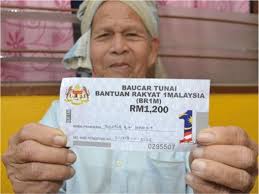
But nearly half of that amount would also be wiped out by annual giveaways under the extended BR1M scheme as promised by both Najib and deputy Umno head and deputy prime minister Muhyiddin Yassin.
What about money from its major cash cow Petronas, which through direct repatriation of profits alone accounts for about 40 percent of the government’s revenue in the last few years?
 But Petronas has reduced contribution to the government to back a higher capital expenditure plan over 2011-2015 to bolster dwindling domestic oil supply. Last year, Petronas profits also took a hit due to instability in Sudan and Egypt.
And don’t forget, BN also promised to hike oil royalty payouts to 20 percent from 5 percent for development of Terengganu, Sabah and Sarawak.
Can the government raise other taxes? Personal income taxes only make up 11 percent of government revenue and the majority of Malaysians do not pay taxes while others evade paying them. And under Najib’s Economic Transformation Program (ETP) to attract US$444 billion investments, corporate taxes are likely to fall, not rise as an incentive.
Subsidies must go
More than that, a weakened BN in parliament also has to push through policies that will hurt almost everyone, economists said. Government subsidies burn a huge hole in government finances every year. It was as large as 16 percent of total expenditure in 2012.
The bulk of subsidies goes to keeping prices of petrol, sugar, rice, transportation and higher education affordable for the growing population in the urban centres. Malaysia has among the lowest petrol, water and electricity prices in Asia and this has been achieved only through government backing, which economists said have distorted the market. Monopoly gas supplier Petronas loses about RM20 billion a year just selling gas at home.
Will the new BN government be able to reverse some of the instituted policies as set down by Mahathir, the so-called father of modern Malaysia, even as his car-making and highway building project now becomes a burden for the Malaysian economy?
Creating value through education
 More than that, the highly open Malaysian economy needs to improve the skills to compete.
“The subsidy mentality should be removed,” Manokaran Mottain, an economist from a research unit backed by Alliance Financial Group said.
BN “should look at long term measures which are aimed at stabilising the cost of living,” Manokaran said. Any credible government has to build more affordable housing and make education affordable. “They need to create human capital which is needed going forward,” he said.
Analysts said that although Malaysia has sharply reduced poverty through economic growth in the last few decades, urban poverty is rising. While unemployment is low, many Malaysians are underemployed as surveys show that university graduate’s pay has not kept pace with inflation and the cost of living in cities.
Furthermore, education is causing a major class division as only richer Malaysians are now able to send their children for quality education in private institution and overseas, from where they often do not return.
 Much of the tauted big investments that Najib’s ETP seeks are for big contract jobs in construction and infrastructure or urban development. These ventures seek and employ cheap workers from overseas who will work at the low minimal wages. Either that, or like for oil and gas sector, they need skilled people that Malaysia cannot produce enough of.
Economists said that Malaysia needs to move up the value chain if it is to remain a globally competitive economy although its engine of growth has recently been largely domestic demand driven. If it’s exports don’t keep up, it could lose out to its Asian neighbours, with a politically-reformed Indonesia already poised to take-off economically..
Just as it happened once in 2008, many Malaysians woke up on Monday with a very different mindset. Some determined to change others wanting things to stay the same.
As the dust settles, it is clear that there are persistent issues, many of them to do with money, that will polarize, maybe even set back the Malaysian economy by at least a decade, if not immediately addressed.
Now that the time for rhetoric is over, will BN change and take the hard measures necessary to firmly put the economy back on track?
Tomorrow: What it means for the markets
You must be logged in to post a comment.