


By Jose Barrock
 The Federal Government is understood to be reviewing some of its big ticket projects, which could result in a review of some infrastructure development plans, sources say.
KiniBiz understands that about a month ago, Suruhanjaya Pengangkutan Awam Darat (SPAD) or the land transport commission, made a presentation to the Economic Council, headed by premier, Najib Abdul Razak, and highlighted the high level of gearing Malaysia is grappling with as a major concern.
“While SPAD does not tell the government what to do, the Commission did highlight the difficulties which the country could face, if the high debt levels are not kept in check.
“SPAD did touch on the MRT (Mass Rapid Transit) Lines 2 and 3,” a source who was present at the meeting said.
He added that the prime minister was silent throughout the meeting.
 All parties involved, SPAD, the MRT Corp—a company wholly owned by the Ministry of Finance Inc and set up to be the developer and asset owner of the project— and other government officials did not want to comment when contacted. The Ministry of Finance did not respond to emailed questions.
But none of the parties KiniBiz spoke to denied that the briefing by SPAD took place.
However another senior government official said that it was unlikely that the MRT lines 2, and 3 would see any change, as they were unlikely to be deferred or scrapped.
“By the time the two lines (MRT Lines 2 and 3) commence work, I believe Malaysia will be on better financial footing,” the Government official said declining to come on record as the meeting was private.
The MRT Line 1 is about a quarter completed and is likely to be completed by July 2017. The first line consisting of 51 kilometres and 31 stations, will link Sungai Buloh to Kajang, while lines two and three are still being firmed up. MRT Line 1 which is slated to cost some RM20 odd billion is likely to be operational by end 2016.
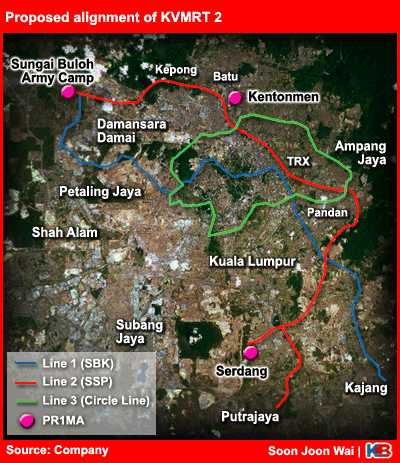 It is the other two that lines that have raised concerns. According to reports the MRT Line 2 will be circular and link areas such as KLCC, the new International Financial District, Pusat Bandar Damansara and Sentul among others, while the MRT Line 3 is now being planned to link Sungai Buloh, Selayang and Pandan instead of the earlier plan which was to connect Kuala Lumpur to Port Klang.
While the exact alignment is not known the three lines are slated to span some 150 kilometres, but the costs of the two new lines are being finalised.
However there is understood to be some trepidation with regards to any delays in the construction of Lines 2 and 3.
“Why should we delay it? It should be all or nothing…there is no point having just Line One, without Lines 2 and 3…it would be half-baked,” a government official said.
 He also highlights that MRT Corp has already invested in machinery and people, so the company should complete the project as soon as possible, or risk losing key personnel and risk the machinery deteriorating when not in use.
A thorn in the Malaysian Government’s side is its high debt levels, which stands at 53% of gross domestic product (GDP). To make matters worse, Malaysia also has among the highest household debt levels in Asia.
The issues plaguing Malaysia are aplenty.
Last week, news reports had it that Malaysia’s current account surplus (net trade in goods and services) is falling at a rapid rate, and was at RM2.6 billion in the second quarter down from RM8.7 billion in the first quarter of 2013, and falling from RM22.9 billion in the quarter prior to that. This decline was brought about by slower exports and increasing imports.
Some say that Malaysia could soon be recording its first current account deficit since the Asian Financial Crisis of 1997.
Then, economic growth for Q2 of this year was pegged at 4.3% over the corresponding period last year, but fell short of economists’ expectations of 4.9%. The tepid 4.3% was achieved despite heavy election spending prior to the 13th General Election in early May this year.
In line with the slowing economy, Central Bank, Bank Negara, cut its forecasts for the year to between 4.5% to 5%, from 5% to 6% expected earlier.
You must be logged in to post a comment.