


By Stephanie Jacob
 KiniBiz met with Keretapi Tanah Melayu Bhd’s (KTM) recently appointed chairman to get his views on the future of the struggling rail operator. Nawawi Ahmad said that he recognised the size of the challenge, but explained that he believed KTM has the right staff and ideas to turn its fortunes around.
____________________________________________________________________
It has been a little over one month since Nawawi Ahmad officially took over the chairman’s seat at Keretapi Tanah Melayu (KTM). In that short time, he has visited most of the company’s key offices and depots, held two sessions with the media and led a staff retreat to carry out what he called a “brainstorming exercise to determine the way forward for KTM”.

Nawawi Ahmad
Although taking on what some might see as a losing battle, Nawawi appears determined to tackle it head on. While it is early days yet, the staff too seem excited by the new chairman’s enthusiasm and ideas.
Nawawi, who is also the member of parliament for Langkawi is an electrical engineer by trade, and began his career in Tenaga Nasional Bhd (TNB). When he left the company in 2004, he had risen from a junior engineer to head engineer for Kedah.
In taking on the job at KTM, the relatively young Nawawi must realise that this is an important chance for him to prove himself. After all, if he can successfully get the national rail operator back on track, he would have rehabilitated one of the oldest institutions in Malaysia. More importantly, he would have succeeded where many before him have failed.
But the magnitude of the challenge that faces Nawawi is substantial. He not only has to find a way to improve the operational aspects of KTM and make the mammoth RM36 billion double tracking work, he also has to formulate a marketing programme to convince people to move from road and air travel back to rail.
Furthermore, in house, the Railwaymen’s Union of Malaya (RUM) which represents the non-executive staff appear to be at massive odds with the senior management, and in particular the president of KTM, Elias Kadir.
Nawawi talks to KiniBiz about the size of the challenge, his vision for KTM and his plans for its future. The interview was conducted following KTM’s recent staff retreat at its training academy in Batu Gajah.
Chairman, can you tell us about your vision for KTM?
The vision for KTM is for it to be the transportation of choice for both passengers and goods in the country, and to provide the best service to suit our customers’ needs.
You mentioned that the purpose of this retreat is to formulate or realign KTM’s business plan in view of the changing business environment. Can you tell us more about the new business plan?
 This new business plan had to be reconstructed and revisited in line with the new developments in the transport industry. For example, we now have a few airlines with an aggressive marketing strategy offering low cost tickets – such as AirAsia, Malindo Air, Firefly and MAS. They are directly becoming our main competitors and we have to strategise over our positioning to be at a sustainable competitive advantage.
At the same time, KTM is going to take over double track permanent ways (railway tracks) all the way from Padang Besar, right down to Gemas this coming November 2014. As such the structure of the business and the business model needs to be changed.
During the staff retreat, 150 staff were divided into four groups which represented the four strategic business units (SBU) – cargo, commuter, Electric Train Service (ETS) and Intercity. I asked them to discuss what they believed were the strengths, weaknesses, opportunities and threats in each SBU.
What would you consider to be KTM’s key weaknesses at this point?
At this current moment, KTM is faced with a few management issues for example cash flow problems, negative profit (losses) of more than RM200 million per year and poorly maintained rolling stock and permanent ways. We are unable to service and overhaul rolling stock due to an insufficient budget.
Moreover with this double track coming to be part of the system very soon, KTM requires a lot more locos (locomotives), wagon and coaches. We have to find ways and means to realign these requirements with new policies or budgets.
Salaries and benefits for the staff are also lower than workers in the same industry and this is resulting in us losing talent to other rail operators.
How about the biggest opportunities?
The biggest opportunities are that we are going to have double track that can be utilised to transport more cargo and passengers without delays.
 On top of that, right now KTM only transports 3% of the cargo business in Peninsular Malaysia, meaning that there is a huge potential of 97% for KTM to grab with the introduction of the double track system.
The same goes for the passenger transportation business whereby with double track and electric trains, a higher number of trips can be introduced with higher reliability and frequency.
We can introduce more customer-focused activities to woo more passengers to use trains as their preferred mode of transport from one place to another in a comfortable environment.
What were some outcomes from the discussions at the staff retreat?
First is profitability We have to improve efficiency and reduce costs through improvement and effective cost management. We also have to look closely at each SBU to determine how we can make it more attractive to the consumer.
We also want to use double tracking to improve our cargo business. Currently, there are 12 trips from Padang Besar and the Pulau Pinang port, and we hope to increase that in the future. Currently the volume travelling on this route is 118,000 twenty-foot equivalent units (TEUs), out of the total yearly cargo volume of 440,000 TEUs. This means that there is a huge potential for growth once the double tracks are ready.
 In terms of practicality, transporting cargo in trains is a preferable option as the vibration created by trains is less than that of ships and lorries. The low vibration levels means that it is better for technological products, car parts and motors for example.
Connectivity is also another issue that consumers face and KTM plans to work together and communicate with other operators to establish ‘synchronization for the last mile and feeders’ – this will make it easier for consumers to travel between stations and other places.
Perhaps KTM can also discuss with Proton or other companies that have car rental services and offer combined services in a single KTM ticket. This will help us realise the concept of being a complete ‘journey planner’.
We also want to focus on human capital development. In terms of improving the efficiency of our staff. We also want to improve in terms of improving our financial performance, which ultimately will allow us to better reward our staff.
Is raising revenue levels the most important thing for KTM?
The answer is no and yes.
No, if we were to operate at the current fare and rate. Because our current rate for cargo has not been revised for 32 years, but our cost of operations has kept on increasing for the past 32 years. At the moment, our cost per unit is higher than our sale per unit.
So we have to readjust our rate first to make it profitable and viable, then we can talk about adding volume in order to increase income and profit.
For now, we are going to increase the price for cargo, so that when we do expand our cargo sector our profits will also grow.
 Will KTM raising cargo rates not affect its ability to expand the cargo sector?
We cannot increase it too much too soon. The government allowed us to increase it by up to three times compared to the current rate. But if we were to raise it by three times, our cargo customers will go to other modes of transportation.
For now we only increase our prices by 20%. We will make the increase slowly and gradually. We must try not to raise it above our competitors’ rates. So we increase, but to below other rates, and not beyond that.
Do ticket prices need to be increased?
I do not like to talk about increasing ticket prices, but we have to adjust our ticket rate to be on par with other train services. We have to be fair to KTM, to the staff who work very hard, to the government and to the people.
You have highlighted double tracking as one of your biggest opportunities – do you think you can achieve sufficient ridership to make the route profitable?
I really have high confidence that we can increase the ridership for this service because the trains will be more comfortable, more convenient, faster, cheaper, safer compared to other modes of transportation.
In short, trains (services) are very much better, provided we can maintain high frequency, reliability, punctuality and reasonably competitive rates.
Has there been a good take up for the service offered on the double track lines that have already been completed?
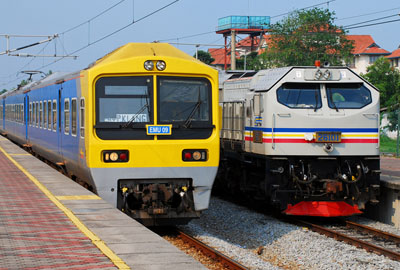 Yes we have had an overwhelming response from the public for our ETS service. As proof, previously there were only two trips per day from Ipoh to KL, but now there are eight trips each way. The passenger segment contributes 50% of total business.
Furthermore, I believe that KTM will be able to get more passengers with the new structure we are going to present to the board which will emphasise a customer-driven business and a high marketing strategy.
One of the problem areas is the intercity service as it is very unprofitable. What are your plans to solve this problem?
Intercity was the first service offered and it has run for over a 100 years. It connects north to south and east to west and is the backbone of connectivity and economic activity. Therefore although it is unprofitable, KTM will continue to provide this service as it is a social responsibility to the people.
But yes, we are losing every day, it is unprofitable. ETS will help us improve, because we can sell our tickets at a higher rate as the (train) environment is better and more comfortable.
You suggested that perhaps KTM should split its services between those that are profitable and those that are not? Can you give more details on this proposal?
Perhaps there may be a way in which KTM and the government can come up with a plan where the various services offered by us are divided into those that are profitable and those are not.
Perhaps the government can help KTM maintain these non-profitable services by helping us financially. So the profitable areas are run as business units, and the other are run as social units and the government must give the money to support.
I have studied the business plans of MAS for example, and there is also Plus Highways where the government helps. So we can look into this as an option, as I think this business model may be more or less suitable for KTM.
RUM has highlighted rolling stock as a key concern for KTM going forward. They say that KTM does not have sufficient stock to fully capitalise on double tracking and that the stock it does have is not well maintained. You have also commented that rolling stock is a concern.
Well there are two categories, namely passenger and freight.
 For freight yes, maybe we have to look at increasing the number of locomotives and wagons due to higher volume. This will have to be dealt with by proposing a new business model for cargo, whereby we can introduce multiple operators.
But KTM will try to get a budget from the government to buy new locomotives and wagons. It is the same for the passenger category whereby right now we are asking for a budget to buy 30 sets of new trains for our business expansion.
As I understand, the government has approved the buying of 10 sets from China and the first set will be arriving in January next year.
RUM has also suggested the idea of multiple operators, as have you, as a possible new business angle? Can you tell us a little more about this option and why it might be workable?
We have no other avenue to get such a large amount of money for rolling stock, especially from the government. If we are going to increase the amount of cargo for example, I need more locomotives and the money involved will be in the billions.
I am not going to get that from the government easily, so the right move is to find any other avenue that will give us sufficient rolling stock. So if others have the money and can come up with their own rolling stock, then they can come and hire our tracks. This will let us make as much money as we would if we had enough of our own rolling stock.
From KiniBiz’s discussion with RUM president Abdul Razak, we understand that there has been a breakdown in the working relationship between the union and senior management. In particular, RUM has sent a memorandum to the Prime Minister and Finance Minister Najib Abdul Razak for the removal of current KTM President Elias Kadir. What is your view on this and how do you plan to handle this problem?
 Actually since I joined KTM, I have spoken to the senior officers union and they have given me their support for my efforts to make KTM successful. I also have met with RUM, and its president. It would seem that they too are committed to helping me and the team.
The problem between RUM and the president is a matter between family, an internal issue. It is seperti secawan kopi (like a cup of coffee), so we maybe just need to add some sugar to make the coffee sweet again (laughs).
Currently the Railway Assets Corp (RAC) holds all the assets, why is this? And is this an effective way to run KTM?
This arrangement is from the time when KTM was being corporatised and privatised. The assets with RAC is meant to be developed so it can help KTM.
Although we are no longer heading to privatisation, the assets still have not been merged with KTM again. So we need to rethink this arrangement and discuss with the government as to how RAC can be with us (KTM).
There has been suggestions that privatisation is the best way forward, what do you think?
I do not agree with that. If you ask me personally, I do not agree with it.
Because we must give KTM’s staff a chance to improve the company and prove to the government that they can make KTM profitable.
I truly believe that they can do it, because we have very good staff. The only thing is, that they are not given the power to do it.
Tomorrow: We look at Nawawi Ahmad’s proposals in greater detail, and consider the privatisation route.
Yesterday: Making a RM36 billion outlay work
You must be logged in to post a comment.