


By Stephanie Jacob

In the second part of our series on the Trans-Pacific Partnership (TPP), we look at two issues that routinely come up. We ask the Ministry of International Trade and Industry’s secretary general Rebecca Sta Maria and chief negotiator J Jayasiri why such a deep level of secrecy surrounds the TPP negotiations and why the government has not undertaken to release any sort of cost-benefit analysis for public evaluation.
Ask the representatives of the Ministry of International Trade and Industry why they think the Trans-Pacific Partnership (TPP) is generating such a storm of negative reaction, and they seem a little puzzled themselves.
It has really taken on a life of its own in the past few weeks, acknowledges MITI secretary-general Rebecca Sta Maria leading an interview between key MITI representatives and KiniBiz earlier in the week.

Rebecca Fatima Sta Maria
Sta Maria highlighted that Malaysia has negotiated and signed a host of bilateral and plurilateral free trade agreements (FTA), which have never garnered so much attention. However, she also acknowledged the fact that the TPP covers a lot more ground than previous FTAs and this is probably part of the problem.
“We have never done such a comprehensive one before. Usually FTA’s cover trade, investment and services; all market access issues. The TPP however includes labour, the environment, government procurement and competition policy… so perhaps that is what is different,” said Sta Maria.
Therefore they accept that they perhaps have not done a good enough job of explaining the concept and positions that MITI and the government are taking with the TPP or the rationale behind pursuing such an agreement.
However they are keen to point out that saying that MITI has done nothing to engage the community is also not fair. Sta Maria notes that MITI has had sessions with health NGOs to discuss potential issues arising from intellectual property rights (IPR) affecting the cost of healthcare; with the Human Rights Commission of Malaysia (SUHAKAM) over human rights concerns and the Malaysian Trade Union Congress over fears that labour rights might be violated and people may lose jobs. MITI has also engaged PEMUDAH, the government-private sector facilitating body, to address transparency issues, which is seen as an important aspect.
 But the concerns still abound. Firstly, there is the issue of secrecy and the lack of a cost-benefit analysis. Many want to know why an agreement that could so profoundly change the landscape of our economy and the way we do business is being negotiated under such a thick veil of secrecy.
This is compounded by the fact that aside from the secrecy, the government has yet to release any sort of cost-benefit analysis. Critics ask why a simple analysis saying how the TPP will boost the economy was not released for public evaluation before the government made the decision to join the TPP negotiations.
Then there are the specifics — issues such as government procurement; intellectual property rights especially when it comes to medicine; the impact of liberalising market access on small to medium enterprises (SME) and Bumiputera businesses as well as America’s role in all this.
KiniBiz put these questions to the MITI Secretary General and J Jayasiri, the chief negotiator for the TPP. Over the next two articles, we will cover some of the TPP’s main sticking points and provide MITI’s response to them.
 Why is it so secret?
To say that the high level of secrecy has been a massive point of contention is a bit of an understatement. Many NGOs and groups, including the Malay Economic Action Council (MTEM) have stated that there cannot be sincere and meaningful discussions without access to the negotiation texts, or a detailed outline at the very least.
On the other hand; academics, law experts and industry insiders all agree that the usual procedure when it comes to international negotiations is to keep it classified, and as such the level of secrecy in this case is not really unique.
KiniBiz asks MITI why it is necessary for these negotiations to be classified and why negotiating documents are kept under wraps.
J Jayasiri: If I make a proposal or request today and this goes public, but this is not what makes it to the final agreement then those countries (the stakeholders of the proposing country) may feel short-changed. So for that reason, negotiating documents are not made public.
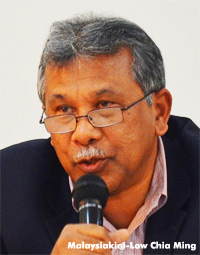
J Jayasiri
You see, it is entirely up to the country that is making a proposal as to whether or not they want to reveal their documents. But I cannot reveal another country’s position because that is the course we have taken and the negotiation document cannot be revealed because we have attributed the positions to other people and it would not be fair. Negotiations have to be done in good faith, so we have to safeguard other peoples’ positions.
KiniBiz: What about the fact that negotiations undertaken by the World Trade Organisation are free for scrutiny on the Internet? Is it true that the final agreement will still be classified for four years?
Sta Maria: Once it has gone through the process of negotiation and then to the Cabinet for approval, the final agreement will be made public. As for the four years… no such thing.
In fact I am sure the Australians will be the first to put it online because that is their requirement.
Jayasiri: There is no such thing (with regards to the four years).
People say that the WTO documents are made public, but the documents that are made public are declassified because they are either agreed minutes of the consensus documents, or the countries have agreed to make it public, or it could be the chairman’s statement. But the actual negotiating documents are only made available to the WTO nations.
Furthermore the WTO documents do not attribute positions to countries, but here we do. Sometimes when you reveal this, then there will be pressure on the governments from their constituencies. There may be queries on why you are taking this position and not that (putting unreasonable pressure) and so on. So this is to let the negotiations proceed in good faith, and this is the practice in all international treaty agreements.
 What we can do is consult on the basis of proposals. We tell stakeholders that this is the proposal and these are the possible implications and ask them, what are your views.
But people are saying we want to see the document, as though they do not trust us when we say these are the issues at stake.
KiniBiz: Why do you think there is this lack of trust?
Sta Maria: Yes there seems to be a trust gap, and nobody trusts us. Although we have been trying to do engagement.
Jayasiri: When we started TPP, we solicited comments on our website. But there were just a few questions and a comment here and there. Nobody came in, in a big way. And we never turned anyone away who asked to be consulted. So to say there was no engagement, is a misrepresentation. We consulted all the stakeholders we felt had to be consulted, and some of them came into the picture much later. Some that we didn’t even know, like MTEM.
 Sta Maria: It is important to also remember that the other ministries also engaged their stakeholders, so it wasn’t just MITI out there. Although it might seem like it. The other ministries have taken the lead in their areas of expertise and have also been negotiating in areas that are relevant to them.
MITI handles areas related mainly to market access.
Why have no cost-benefit analysis studies been released?
In discussing the TPP issue with KiniBiz, opposition MP Wong Chen highlighted that there has been no release of a cost-benefit analysis on the economic and commercial impact of the TPP to the nation.
“They have not made a case on where or where we might not get a surplus on the export…and that is the first crucial thing we should look at. How much are our exports going to increase?” asked Wong. Pointing out that this has nothing to do with secrecy, he said it was a basic requirement that would justify entering into this agreement in the first place.
Following a meeting between MITI and representatives from Pakatan Rakyat, the ministry agreed to look into releasing an independent cost-benefit analysis that was done by the United Nations Development Programme (UNDP) a few years ago.
 MITI has said that it will look into how it might be able to release the document, albeit without the negotiating positions put forward by the UNDP.
KiniBiz asks MITI why it has not released any cost-benefit analysis of its own and if there is any development in their plans to release the UNDP study.
Jayasiri: To get us to decide whether to go in or not, we need to have a baseline study. The UNDP study was done as an independent one.
But normally before we go and get Cabinet’s mandate to start negotiations, we prepare a memorandum which contains all the views of the various ministries and stakeholders, such as businesses and in some areas we get relevant NGO opinions.
Most people think that you do a cost-benefit analysis and that should be the basis on whether to go in or not. But before you go into negotiations, you also have to make a fair amount of assumptions.
In the actual negotiations some of these may never surface and some might go beyond what your initial assumptions were. So we have to continue our consultation throughout the negotiations to see what will be the impact on Malaysia if we accept certain things.
 Sta Maria: Before we go in, we do our own (studies)…but that is just for ourselves (an internal study). But the UNDP one is an independent study.
After every single round, we do one again because new issues have come up. So we have another round of engagement to look at the cost and benefits, as it were, on each of this issues. In order to see what positions we should take, so it is an ongoing process.
We are looking to see how we can release the UNDP study and deciding what is the best way to do that, either through a public release or to release it with a non-disclosure agreement.
KiniBiz: Ultimately the eventual outcome will depend on the final agreement, and this means it would be difficult to measure the cost and benefits at this point, right?
Jayasiri: Yes at the end of the day, when the negotiations are over, we have to do another cost-benefit to table to the Cabinet, and the Cabinet will have to decide whether the costs outweigh the benefits or the other way and only then will they decide whether to sign and ratify.
Once the negotiations are over it is not a given that all countries will accept the final agreement.
Tomorrow: Some of the sticking points
Yesterday: Should we be afraid of the TPP?
You must be logged in to post a comment.