


By Jose Barrock
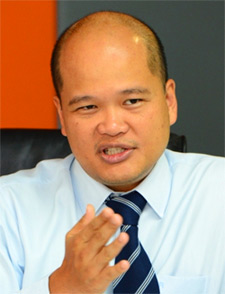
Shahril Ridza Ridzuan
The chief executive officer of the Employees Provident Fund (EPF), Shahril Ridza Ridzuan is not an easy man to catch. With more than RM500 billion in its coffers, the EPF is among the largest funds in the world, generating interest with its every move. Now with the pension fund commencing development of the 2,300 acre Rubber Research Institute land, the goings-on in the UK’s Battersea, and disputes with state-controlled Perbadanan Kemajuan Negeri Selangor (PKNS) or Selangor State Development Corp, Shahril has been thrust into the limelight. In an exclusive interview with KiniBiz, Shahril sheds some light on the goings-on at the pension fund’s property ventures.
Here are excerpts of the interview.
KiniBiz: How does the Rubber Research Institute (RRI) land in Sungai Buloh figure with you. Is the EPF going to be an active developer?
We are not a developer… We don’t intend to be a developer. What we have done at Sungai Buloh is similar to Khazanah at Iskandar, where we craft the master plan for the entire development as well as predetermine the infrastructure requirements, plot ratios and overall planning.
What we are going to do is have RFPs (requests for proposals) for the immediate parcels of land for interested developers, who will bid for the parcels. Then we will either conduct an outright sale to them or if we feel there is long term-value we will do a joint venture. They will do all the actual development. Our role will be that of a financial investor, master planner and coordinator. We have to make sure development is coordinated across the whole area.
We don’t intend to be an active developer. We are focused on finding the right development partners.
 KiniBiz: So you have to deal with the Selangor State Government for this?
Of course.
KiniBiz: How have the negotiations been?
The state government has been very supportive, They obviously want to see the right development as it’s economically beneficial to them as well…Rather than leaving it (the 2,300 acres) as Rubber Research Institute land, which generates very little income for them, by progressively developing it in a sustainable way, they (the Selangor state Government) are going to get much higher quit rents and see more economic activities. There will be more job creation along with a whole host of benefits in the development of the land.
What we have committed to both the State and Federal Governments is that the entire master plan will be very green in nature. So we are actually reserving a high percentage of the area for green lungs, parks etc. But we need to get a commercial return for our contributors.
KiniBiz: At what stage are you now with the Sungai Buloh land?
Our team is in the process of getting submissions done with the state for approvals.
In terms of investment strategy we like land, because land inherently has a scarcity value, especially big pieces of land like this, in very good areas, so it acts very well as a natural inflation hedge in terms of pricing. One of the big issues that we have, is inflation hedging for our contributors.
 KiniBiz: So you have had no issues with the state?
I think to say there have been no issues would be wrong, but we have the usual negotiations with them on the requirements. We have to reach a balance between what the state sees as its social or economic objectives, and what is a viable economic investment for us.
Obviously if you ask the state they will want all sorts of stuff, but they also recognise that there has to be a process of discussion as to what can be done on the land, and we are more than happy to accommodate as much as possible. I think in that sense we are both aligned, in that we both want a sustainable development there which can generate long-term returns for both the state and us.
KiniBiz: There have been rumours that the state may throw a spanner in the works (with the Sungai Buloh development).
To be fair, so far discussions have been fairly cordial. Take any developer negotiating with a local authority and there will always be request or demands. It’s always about reaching a balance. It’s natural, talk to any developer in any state, it doesn’t have to be Selangor, local authorities will always push the boundaries…it’s their job.
 KiniBiz: You have said that the land in Sungai Buloh is worth about RM300 per square foot now, but how much did you get the land for?
When we bought it from the Government we bought it at about RM20 per square foot. But that was agricultural land; we had to pay for the conversion, development charges.
KiniBiz: Do you take ownership of the assets in the development?
If it is a shopping mall or an office building, we will be very interested to own it, for income purposes. We will probably take small stakes in the developments to make sure there is no deviation from the original plans.
KiniBiz: What about PKNS and Nusa Gapurna? (To recap – Nusa Gapurna Development Sdn Bhd which is 40% owned by the EPF and 60% owned by businessman Mohamad Salim Fateh Din had entered into an agreement with Malaysian Resources Corp Bhd (MRCB) to inject parcels of land into MRCB, for shares. PKNS has 30% equity interest in one of the lands, in Petaling Jaya where PJ Sentral is slated to be developed. PKNS has offered a higher price than the valuation done in the injection into MRCB, and contested the pricing of the deal, and has said that there is a breach in the shareholders’ agreement).
That’s a different issue. There’s a difference of opinion. This (RRI land) of course has a much bigger value to the state.
To be fair the state has been very cooperative, the state has been very helpful getting all the approvals for the MRT.
So this idea that there is always going to be conflict with the state, just because there are political differences between Federal and State is not right. Where there is a common good, or common objective, I have never had an issue with both sides working together. I think that should be the way, it is a maturing of the economy and the market.
 KiniBiz: Back to PKNS and Nusa Gapurna? Did it come as a surprise to you that PKNS objected?
In a way I was a little surprised. We felt it was a fair deal, but to be fair to PKNS, it is well within their rights to challenge the assumption.
At this stage it can go two ways, either we all sit down and have a chat and come to an amicable commercial resolution, or we can go to court…sometimes there is just no way to resolve a dispute without arbitration.
Basically it’s well within their rights to challenge our interpretation, as it is well within our rights to challenge theirs…right now it seems to be headed to court. But being reasonable business people we are always open to have a discussion and resolve the issue.
KiniBiz: If you carve out PJ Sentral, would it make a huge difference to the deal, the takeover by MRCB?
In terms of value of that portion of the transaction, it is about RM200 million from the entire size of RM700 odd million. So it is a significant portion.
There are other lands being injected, which are also very valuable, so we’ll see when the time comes. If the court doesn’t rule in MRCB’s favour, we have to sit back and see what can done.
(Shahril declined to comment much on the on-going dispute with PKNS, as it was headed for the courts)
 KiniBiz: What about Battersea? How hands on are you at Battersea? (The EPF has 20% in the Battersea development in UK, while the remaining 80% is held equally by Sime Darby Bhd and SP Setia Bhd).
We are purely a financial investor, we don’t interfere in the management…We know what we are good at, we are good at investment analysis, we are good at good at risks based analysis, but we are not developers.
Honestly with SP Setia and Sime Darby there, you have the two biggest property companies in Malaysia, I really don’t think we can add value from a development point of view, but from a financial point of view, we can (add value).
We are also part of the oversight committee (for the Battersea development), just to make sure the governance is adhered to, that there are proper processes.
Then again you can see from the success they have had, through the first phase that it is a good management team combining Malaysian and British teams.
Q. But you know people with more experience in property have failed at Battersea?
It’s about different concepts… to be honest the major difference is that this consortium has access to the Asian market, Asian buyers.
There was a gap in the market, and that there were a lot of interested buyers (from Asia), but they (the Asian buyers) had no access as they had no familiarity with the developers. They were worried as to who would handle the customer relationship, going forward.
Now, it’s actually like this, if you have any problems you can call us in your home country, in Malaysia or Singapore or Australia….you don’t have to call someone who is eight time zones away to try and get your problem fixed.

Liew Kee Sin
Liew (Kee Sin president and chief executive officer of SP Setia) has said, if between Sime Darby, SP Setia and EPF you cannot sell 800 units in Asia, then something is wrong. And that is what it boils down to.
It is the confidence of the markets here in Asia with the development team.
KiniBiz: What about Liew’s leaving…could it be a problem? (Liew is slated to leave SP Setia in March 2015, but is likely to walk much earlier, some say even within a year or so. To recap — In September 2011, PNB made a bid to take over SP Setia, offering RM3.90 per share and 91 sen per warrant. While the offer was rejected, Permodalan Nasional Bhd (PNB) acquired shares in SP Setia on the open market and breached the 33% threshold and made a general offer for all the remaining shares it did not own. After much resistance, PNB upped the offer to RM3.95 a few months later, and made Liew part of the takeover offer, with an option for him to exit at RM3.95 per share).
I think people come and go, we were always aware of this possibility. It was no secret, PNB had already made the (general) offer for SP Setia’s shares, and he (Liew) was already in discussions on his put option, but the SP Setia team is very strong, it’s not Liew alone. Of course he is the name and the face, probably one of the best property developers around, but the team on the ground is almost entirely British.
If he decides to move on we will miss him, but knowing Liew, he will always be available for us to tap into his ideas.
You must be logged in to post a comment.